
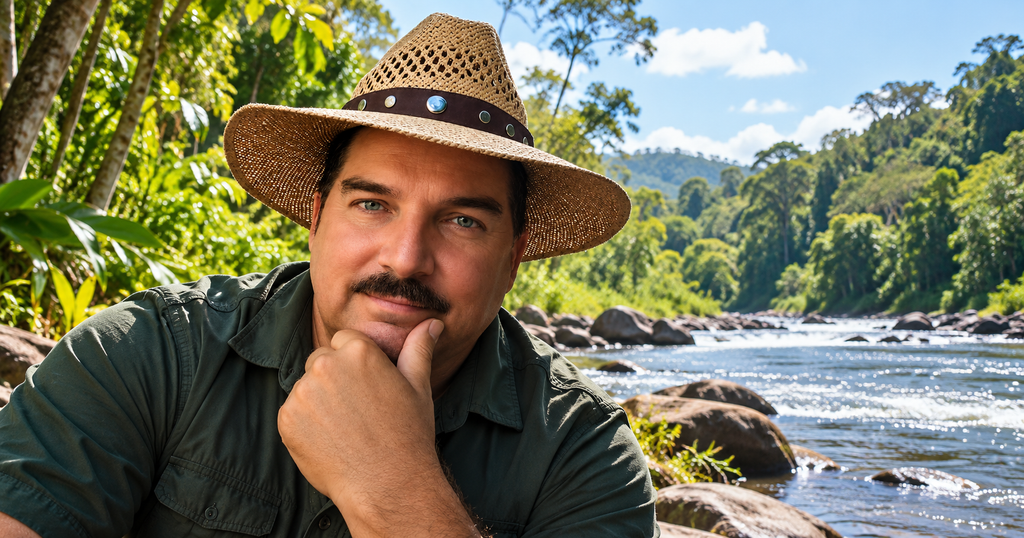
Pastor Jedidiah Wayne Gaines
Missionary • Pastor • Author • Teacher • President of CrownLife International
Pastor Jedidiah Wayne Gaines is an American Christian missionary, pastor, author and ministry leader whose involvement in international missions began as a teenager and has continued for more than four decades.
Known throughout much of his earlier missionary history simply as Wayne Gaines, his ministry developed principally through Latin America—particularly Costa Rica and Honduras—before expanding into international ministry relationships, humanitarian work, indigenous pastoral partnerships, teaching, publishing, music and digital ministry.
His story is not the story of a single organization. It is the story of a calling that has passed through different seasons, organizations and expressions while retaining a central conviction:
It all has to be about Jesus.
Today, Pastor Jedidiah serves through CrownLife International and related ministry initiatives, continuing a missionary calling that began in his youth.
Identity & Name History
Pastor Jedidiah Wayne Gaines was born Dennis Wayne Gaines and was known by his middle name, Wayne, throughout his childhood and for most of his early adult and missionary life.
Consequently, historical documents from the 1980s, 1990s and 2000s frequently identify him as Wayne Gaines, D. Wayne Gaines, or Dennis Wayne Gaines.
Following a deeply significant spiritual experience concerning the biblical name Jedidiah—meaning “beloved of the LORD”—he increasingly became known in ministry as Pastor Jedidiah.
His name was subsequently changed legally from Dennis Wayne Gaines to Jedidiah Wayne Gaines, effective March 6, 2018.
Accordingly, historical references to Dennis Wayne Gaines, D. Wayne Gaines, Wayne Gaines, “Jedidiah” Wayne Gaines, Jedidiah Wayne Gaines, Pastor Jedidiah Wayne, and Pastor Jedidiah within the corresponding ministry record refer to the same individual.[1]
This distinction is particularly important because much of his early missionary history predates the legal name change by several decades.
Conversion and the Beginning of a Calling
The documented ministry chronology begins on September 10, 1979, when Wayne Gaines, then fifteen years old, came to faith in Jesus Christ and was baptized in Slidell, Louisiana.
International missions entered his life almost immediately.
In 1980, at age sixteen, he traveled to Honduras on his first mission trip. He returned in 1981, and his involvement with the people and ministry of Honduras continued to deepen.[2]
In 1982, following high-school graduation, Wayne returned to Honduras intending eventually to attend Christian college and prepare for youth ministry. During that period, however, he experienced what he describes as God’s call to become a missionary to Latin America—the experience from which the title of his autobiographical account, Called Out To A Foreign Field, was taken. The surviving historical timeline records that calling in 1982.
The direction of his life changed.
Costa Rica: Language, Culture and Missionary Formation
In August 1982, at eighteen years old, Wayne moved to Costa Rica, where he lived and served among a missionary team of approximately ten families while learning Spanish and Latin American culture. The historical record describes this period as the foundation for the native-level Spanish fluency and cross-cultural understanding that would become essential to his later ministry.
Pastor Jedidiah’s recollection also honors missionaries who preceded his full-time arrival in Honduras, including Rene Barrios and his family and Eddie Danta and his family. According to his present reconstruction of those early years, they had served around Catacamas before relocating to Costa Rica, where that connection helped open the door for his own period of missionary formation.
He also remembers with gratitude Missionary Ronald McClung, under whose leadership the missionary team in Costa Rica permitted the young missionary to live, learn and serve among them.
Where exact dates concerning those early relationships remain approximate, they are intentionally presented as personal historical recollection rather than given false documentary precision.
Honduras: A Young Missionary Goes to the Field
In 1983, at approximately nineteen years of age, Wayne moved to Olancho, Honduras, as a self-supported missionary. The historical timeline also records that he established an export business with Rick Machen Jr., initially known as International Imports, helping provide an economic foundation while he pursued missionary work.
Those early years in Honduras involved evangelism, discipleship, relationships with local churches and leaders, travel into rural communities, practical development work and an increasing conviction that sustainable missions required more than the presence of foreign missionaries.
It required equipping indigenous believers and leaders.
That principle would become one of the enduring threads running through the decades that followed.
Honduras Bible School
One expression of that conviction was the development of the Honduras Bible School.
The historical manuscript Called Out To A Foreign Field identifies Wayne Gaines, Ronnie E. Carter and Richard Machen Sr. as members of the school’s founding board.[3]
The school was established to prepare Honduran ministers—particularly men coming from rural communities, mountains and remote areas—and equip them to return to their own people with biblical and practical ministry training.
The curriculum combined Scripture and pastoral preparation with practical leadership. The historical record also describes cooperation with the developing medical work that became Predisan.
Over subsequent years, generations of Honduran ministers passed through the school, with the broader historical record crediting its graduates with helping establish more than seventy congregations, particularly in eastern Honduras.[2]
Predisan: Preaching and Healing
Another important development was Predisan, the Christian medical mission established in the Catacamas area.
Wayne and Rosemary Gaines, together with Dr. Robert and Doris Clark, Honduran workers, medical personnel, volunteers and other fellow laborers, participated in the formative period of the ministry.
The historical record preserves a particularly significant detail concerning the organization’s name.
While studying the biblical pattern of Jesus preaching the Kingdom and healing the sick, Wayne proposed combining two Spanish verbs:
PREDIcar — to preach
SANar — to heal
PREDI + SAN = PREDISAN
Importantly, this attribution does not rest solely upon later personal recollection. A 2017 Predisan Manual of Spiritual Formation, preserved in the historical timeline, recounts the organization’s early history and identifies Wayne and Rosemary Gaines as joining during the first year. It also attributes to Wayne the observation that the mission reflected Luke 9:2—preaching the Kingdom of God and healing the sick—and records the PREDIcar + SANar = PREDISAN formulation.[4]
This historical recognition does not diminish the work of the Clark family, physicians, nurses, Honduran health workers, volunteers, supporters or subsequent generations of Predisan leadership. Predisan became what it became through the service of many people.
That principle governs the telling of this entire history:
No ministry story is ever the work of one person alone.
One Building, Several Ministries
The early work in Catacamas became unusually interconnected.
Called Out To A Foreign Field records an early ministry facility in which the Predisan medical clinic occupied the front, Honduras Bible School classrooms occupied the middle, and a local church met toward the rear.[3]
The surviving timeline places Wayne at work on the first building constructed for the Honduras Bible School and Mission Predisan in 1987. That building would later serve several ministries and organizations across different periods.
It illustrates something characteristic of those years: missions, medical work, education, discipleship and community development were not isolated enterprises. They frequently grew beside and through one another.
Good Samaritan Christian School
Another branch of this developing work became the Good Samaritan Christian School.
The historical account gives particular attention not merely to the institution but to the people whose lives became part of its story.
Tanita de Matamoros, remembered as one of the earliest people Wayne led to Christ following his arrival in Catacamas, became the school’s first teacher and director. Her husband, Marcio, later came to Christ, became one of the early church elders and continued serving for decades.[3]
Their story represents something Pastor Jedidiah considers more important than institutional longevity alone:
fruit that produces more fruit.
Children became adults. Disciples became servants. Families carried faith into another generation.
The missionary record summarizes the pattern:
Missionary → Disciple → Servant → Family → Children → Grandchildren
The broader ministry record identifies Good Samaritan Christian School among the enduring institutional fruit of those early missionary years.
Rancho Paraíso, the Journey Program and Honduras Outreach
The missionary history also intersects with the development of a rural ministry base near San Esteban, Olancho.
The historical chronology records an exploratory journey in 1984 seeking land suitable for a mission camp. The developing project became associated with Rancho Paraíso, agricultural and vocational work, and what became the Journey Mission Program.[2]
Wayne and Rosemary later worked with others in the development of the Vo-Ag project and Journey program. The historical record particularly honors Richard Machen Sr. and Louise Machen and the wider Machen family for vision, generosity and sustained involvement in these efforts.[3]
The property and ministry subsequently developed under what became Honduras Outreach, creating another example of a seed planted in one season continuing to grow under different leadership in another.
The surviving historical material explicitly connects the earlier Vo-Ag Project and Rancho Paraíso with the later Honduras Outreach ministry.
Mission Del Caribe
A major organizational chapter of Pastor Jedidiah’s ministry history is Mission Del Caribe.
Mission Del Caribe was formally organized as a nonprofit international ministry in the early 1990s. Wayne served for many years as a board member and officer and later in executive leadership.[2]
The ministry’s roots were deeply connected to Latin America, but its reach subsequently expanded.
During these years, ministry included evangelism, mission teams, medical and humanitarian work, development projects, disaster response and support for national Christian leaders.
Pastor Jedidiah’s leadership became particularly associated with disaster-response efforts following major catastrophes in Central America.
Hurricane Mitch and Disaster Response
When Hurricane Mitch devastated Central America in 1998, Mission Del Caribe and its network of workers, churches and supporters became involved in relief, reconstruction and community assistance.
The work included humanitarian relief, rebuilding, evangelistic ministry and economic-development efforts. The historical record describes substantial resources being entrusted to the response and a multi-year recovery effort.[2]
In 2001, following the devastating earthquakes in El Salvador, Wayne organized what became known as the MDC Disaster Assistance Response Teams (DART).
Working with Salvadoran church leaders and ministry relationships in Honduras—including people connected with the Honduras Bible School and medical ministry—the team mobilized personnel, supplies, funds and practical assistance.
The surviving timeline records Wayne’s involvement on the ground in El Salvador and his work with Salvadoran and Honduran ministry partners.
Journey Mission Camp and Trujillo
During another period of Honduran ministry, Wayne and Rosemary lived and worked in Trujillo, on Honduras’ Caribbean coast.
There they continued local church involvement and helped re-establish the Journey Mission Camp after the earlier Rancho Paraíso property entered the next stage of its development.[2]
Journey created opportunities for mission teams, young people and volunteers to encounter missions directly—not merely as an idea, but through relationships and service.
From Latin America to a Wider International Field
By the late 2000s, the geographic scope of the ministry widened considerably.
In 2008, following a renewed sense of calling, Wayne entered a new season of Mission Del Caribe leadership and international expansion. Ministry relationships increasingly reached beyond Latin America into nations including Pakistan, Bangladesh, India and Kenya, with particular attention to indigenous ministers, pastors, children, widows and vulnerable families.[2]
This reinforced a principle already learned in Honduras decades earlier:
The goal is not to make indigenous ministries permanently dependent upon foreign missionaries. The goal is to strengthen faithful local leaders who can minister effectively among their own people.
That conviction eventually became increasingly visible through relationships with indigenous pastors and what developed as the Native Pastors Network.
Yeshua Full Measure Ministry
From 2011 through 2015, another expression of the ministry operated as Yeshua Full Measure Ministry, an outreach associated with Mission Del Caribe.
Its governing emphasis was summarized in the phrase:
RAISING UP REAPERS
Archival records describe its purpose as building up the Body of Christ, reaching the lost and equipping believers to do the work of ministry, with the goal of growing into the “full measure of Christ.” The same historical material preserves another declaration that has remained central to Pastor Jedidiah’s ministry:
IT ALL HAS TO BE ABOUT JESUS!
CrownLife International
Over time, the continuing international work developed into its present expression through CrownLife International.
CrownLife represents both continuity and expansion: the missionary calling remains, while the methods and geographic relationships have continued to develop.
Its work has included relationships with indigenous pastors and ministries, humanitarian assistance, evangelism, discipleship, teaching resources and support for ministry among children, widows, families and communities.
The central objective remains not the creation of an empire bearing one person’s name, but the strengthening of people who themselves become fruitful.
Native Pastors and Indigenous Ministry
One of the clearest lessons of more than four decades of missions has been the importance of indigenous leadership.
Local pastors know their language, culture, communities and people in ways an outside missionary never fully can.
Pastor Jedidiah’s present ministry therefore places significant emphasis on relationships with indigenous pastors and ministries—helping equip, encourage and strengthen leaders already serving within their own nations and communities.
The desired multiplication is not:
one missionary reaching everyone.
It is:
disciples making disciples, pastors equipping believers, churches strengthening communities, and fruitful people producing further fruit.
Author, Teacher and Publisher
Writing has accompanied Pastor Jedidiah’s missionary life for decades.
His autobiographical manuscript Called Out To A Foreign Field preserves much of the firsthand history underlying this biography and serves as a principal narrative source for the chronology presented here.[3]
Over the years he has also produced Christian teaching, books, ministry resources, children’s materials and other written works.
The purpose is fundamentally generational: to preserve what has been learned so that another person does not have to begin at zero.
Kingdom Tunes, Pointing to Jesus and Digital Ministry
Later ministry expressions have increasingly used digital media to make Christian teaching and resources available beyond the limits of physical travel.
Kingdom Tunes distributes music and related Christian resources with an emphasis on generosity and accessibility.
Pointing to Jesus expresses the most basic objective behind the broader ministry ecosystem: whatever the medium—missions, teaching, humanitarian service, books, music or digital media—the direction should ultimately point beyond the messenger to Jesus Christ.
Teaching and media through CrownLife and related platforms continue this same work in contemporary forms.
The medium has changed repeatedly.
The calling has not.
A Ministry Carried by Fellow Laborers
Pastor Jedidiah’s historical record deliberately rejects the idea that decades of ministry can properly be attributed to one individual.
The acknowledgments of Called Out To A Foreign Field begin with the principle:
“No ministry story is ever the work of one person alone.”
First among those fellow laborers is Rosemary Gaines, whose life, family, work and sacrifice became inseparable from the missionary story.
The record also honors people including Ronnie E. Carter; Richard Machen Sr.; Louise Machen and the Machen family; Rick Machen; Jorge Quijano; David and Suyapa Chacón; Carlos and Roxana Ulate; Jack Odem; Ken and Donna Ellis; Steve and Lisa Edelhuber; Dr. Robert and Doris Clark and family; medical workers; pastors; teachers; supporters; volunteers; indigenous believers; churches; and many others whose service became part of the harvest.[3]
Some planted.
Some watered.
Some built.
Some taught.
Some healed.
Some preached.
Some gave.
Some prayed.
Some opened their homes.
Some carried the missionary when he could not have continued alone.
The story belongs ultimately to God.
The Growth Rings of a Lifetime of Ministry
Viewed across more than four decades, the history can be understood through several broad periods:
1979–Early 1980s — The Seed and Calling
Conversion, early mission exposure, surrender and calling.
1982–1990s — Early Missionary Foundations
Costa Rica, Spanish-language and cultural formation, Honduras, evangelism, discipleship and indigenous relationships.
Mid-1980s–2000s — Institution Building
Honduras Bible School, Predisan, Good Samaritan Christian School, Rancho Paraíso, Journey and related ministry infrastructure.
1990s–2000s — Expanding Ministry
Mission Del Caribe, humanitarian work, disaster response, community development and broader international relationships.
2008–2010s — New Expressions
Renewed international expansion, Yeshua Full Measure Ministry, teaching, discipleship and ministry beyond Latin America.
2010s–Present — Multiplication Through Indigenous Leaders
Increasing emphasis on native pastors, churches and locally led ministries.
2020s–Present — Continuing Fruit
CrownLife International, Pointing to Jesus, Kingdom Tunes, books, teaching, digital resources and continuing missionary relationships.
The chronology is not intended to imply that one period ended neatly when another began. Like the growth rings of a tree, earlier seasons remain inside everything that followed.
From a Surrendered Seed to Continuing Fruit
The image that perhaps best summarizes the history is a tree.
The roots are Jesus Christ, Scripture, prayer, surrender and obedience.
The early missionary years formed the trunk.
Different seasons produced different branches.
Some institutions continued under new leadership. Some ministry expressions changed names. Some assignments ended. Others expanded far beyond anything imagined when they began.
But the most important fruit cannot be measured merely by organizations, buildings or programs.
It is found in people.
People who came to Christ.
Pastors who were equipped.
Believers who became disciples.
Children who became adults.
Families who carried faith into another generation.
Local leaders who became missionaries to their own people.
And some of those trees are now producing seed of their own.
That is why the historical record is not principally presented as a résumé of accomplishments.
It is testimony.
The seed was surrendered. God gave the increase. The fruit is for His glory.
Documentary Record & Further Reading
This biography is based upon a larger historical and documentary record accumulated across more than four decades. Readers wishing to examine the history in greater depth may consult the following:
Called Out To A Foreign Field — Pastor Jedidiah Wayne Gaines. Firsthand autobiographical narrative and principal narrative source for the early missionary history.
Pastor Jedidiah & Rosemary — Historical Timeline (Sutori) — A long-form chronology preserving photographs, dates, institutional history and documentary material relating to the Gaines family’s missionary work.
Our Ministry Tree — Detailed Historical Record & Documentary Companion — A consolidated historical record organized around the roots, growth rings, institutions, partnerships and continuing fruit of the ministry.
Predisan — Manual of Spiritual Formation (2017) — Institutional historical material preserving Predisan’s account of its formative period and the PREDIcar + SANar naming history.
Dick Parker, They Call It Paraiso — Published historical material concerning the ministry and development associated with Rancho Paraíso.
Charlie Walton, Travels With The Jungle Doc — Published material relating to the Honduran medical-mission environment.
Additional historical evidence includes institutional records, archived ministry materials, photographs, contemporaneous publications and the records of organizations that intersected with the work.
Source Notes
[1] Identity and name record. Historical records identify the same individual variously as Dennis Wayne Gaines, D. Wayne Gaines and Wayne Gaines. Later records identify him as Jedidiah Wayne Gaines and Pastor Jedidiah. Administrative documentation in the Gaines archive records the legal change from Dennis Wayne Gaines to Jedidiah Wayne Gaines as effective March 6, 2018.
[2] Pastor Jedidiah & Rosemary — Historical Timeline (Sutori). This chronology preserves the September 10, 1979 conversion; 1980 and 1981 Honduras trips; 1982 missionary calling and Costa Rica period; 1983 move to Honduras; Honduras Bible School history; Predisan; Journey/Rancho Paraíso; Mission Del Caribe; disaster response; and subsequent international ministry. The surviving record explicitly places the 1982 move to Costa Rica among a team of ten missionary families and the 1983 move to Olancho, Honduras.
[3] Gaines, Jedidiah Wayne. Called Out To A Foreign Field, final-master manuscript. Principal autobiographical source. Relevant sections document the Honduras Bible School, Predisan, Good Samaritan Christian School, Journey/Rancho Paraíso and the fellow-laborers who participated in the work.
[4] Predisan, Manual of Spiritual Formation (2017), historical section, as preserved in the Sutori historical record. The historical account identifies Wayne and Rosemary Gaines among Predisan’s early workers and attributes to Wayne the PREDIcar + SANar = PREDISAN formulation associated with the biblical pattern of preaching the Kingdom and healing the sick.